

Search Archives
Follow Us

What's New

Mailing List
Email Newsletter icon, E-mail Newsletter icon, Email List icon, E-mail List icon Sign up for our Email Newsletter
For Email Marketing you can trust
Twitter Feeds

This site utilizes the MLB analytics platform powered by TruMedia Networks

Entries in Doug Fister (7)

Friday
Sep282012

Fister's Command Key to AL Consecutive K Record

It's not terribly surprising that a Detroit Tigers starting pitcher set an American League record by recording nine straight strikeouts yesterday against the Kansas City Royals. That it was Doug Fister, rather than K mavens Justin Verlander or Max Scherzer, is shocking. Fister didn't throw a single pitch over 92 MPH while coming within one K of tying Tom Seaver's all-time record, relying upon superb command to fan K.C.'s entire lineup.

Check out Fister's pitch location on his nine consecutive Ks. He went high, low, inside and outside, straddling the corners and avoiding the fat part of the plate:

Fister caught six Royals looking during that sequence -- all of them on four or two-seam fastballs. His K rate has spiked to a career-best 7.7 per nine innings pitched this season thanks in part to his ability to freeze hitters with two strikes. Fister trails just David Price among AL starting pitchers in looking strikeouts:

PitcherStrikeouts Looking
David Price 83
Cliff Lee 74
Yovani Gallardo 73
Joe Blanton 69
Vance Worley 61
Doug Fister 60
James Shields 60
Clayton Kershaw 58
A. J. Burnett 57
Justin Verlander 57


Just like he did in yesterday's start, Fister has racked up looking strikeouts this season on pitches thrown to the corners. The six-foot-eight righty is especially fond of tossing glove-side pitches that catch the edge of the plate:

Location of Fister's looking strikeouts in 2012

While Fister will never be confused with Verlander or Scherzer, he has improved his K rate from Kirk Reuter-esque levels (4.9 K/9 during his first full season with the Mariners in 2010) to the point where he easily bests the 7 K/9 average for AL starting pitchers this season. Power stuff misses bats, but Fister proves that quality command can also induce lots of Ks. Just ask the Royals.


Saturday
Jan282012

Porcello, Fister Should Fear Detroit's Infield D

The Detroit Tigers' decision to put $214 million man Prince Fielder at first base instead of DH and move Miguel Cabrera, who last played third base regularly five years and fifty pounds ago, to the hot corner has some wondering whether Detroit's quest for maximum offense might produce the worst defensive infield seen in years.

Justin Verlander and Max Scherzer probably aren't too worried, considering both are high-strikeout hurlers who induce fly balls when hitters do make contact. But Rick Porcello and Doug Fister, who put the ball in play and on the ground much more often, might be sweating the prospect of pairing the plus-sized corner infielders with shortstop Jhonny Peralta and a combination of Ryan Raburn and Ramon Santiago at the keystone.

Porcello's punchout rate (13.3% of batters faced) ranked in the 18th percentile among starting pitchers (meaning he was worse than 82 percent of starters). Fister (16.7 K%) fared better, but he still placed in the bottom half (45th percentile). With few Ks, Porcello and Fister both ranked in the top 20 among American League starters in the percentage of pitches swung at put in play:

PitcherIn Play Pct.
Joel Pineiro 53.6%
Brad Penny 51.2%
Jeff Francis 50.4%
Nick Blackburn 50.1%
Phil Coke 49.7%
Trevor Cahill 49.0%
Mark Buehrle 48.9%
Freddy Garcia 48.4%
Carl Pavano 48.3%
Rick Porcello 48.0%
Ivan Nova 48.0%
Blake Beavan 47.9%
Tyler Chatwood 47.5%
Zach Britton 47.3%
Josh Tomlin 47.2%
Tim Wakefield 46.5%
Bartolo Colon 46.5%
Jeremy Guthrie 45.9%
Brett Anderson 45.7%
Doug Fister 45.6%


And when batters put the ball in play against these two, it's often on the grass. Both had ground ball rates above the league average, with Porcello burning worms 54% of the time and Fister doing so 47%. Lots of balls in play, and lots of grounders: not a good combination for a club with four infielders whose best position is "hitter."

Porcello bore the brunt of sloppy infield D in 2011, as he had a .283 batting average on grounders put in play. That was 44 points above the league average for starters and was fourth-highest among AL starters (teammate Scherzer was third, though he had far fewer grounders put in play). Fister, by contrast, enjoyed a .196 BABIP on grounders while spending most of the season in Seattle. Suffice it to say, that's not likely to happen in 2012.

Miggy, Prince, Peralta and Raburn make for a formidable infield offensively, and their defensive foibles might not get that much notice on days when Verlander and Scherzer (second and 17th, respectively, among AL starters in K rate) are on the bump. But when pitch-to-contact, ground ball-centric pitchers like Porcello and Fister take their turns, look for lots of singles.

Wednesday
Oct122011

Rangers Can't Resist Fister's Fastball

Doug Fister pitched the Tigers into the win column in the ALCS last night, surrendering two runs in 7.1 innings while striking out three and walking none. The former Mariner got 73 strikes in 102 pitches (72 percent), but he didn't do it by flooding the zone with strikes. Rather, he baited Rangers batters with fastballs off the plate.

Fister threw his fastball three-quarters of the time against Texas. Manager Jim Leyland praised Fister's approach: "In and out, moving the ball around, moving the ball both sides of the plate." Facing a lineup with seven right-handed hitters, the NBA-sized righty mostly pitched inside but did hit the outside corner to keep 'em honest:
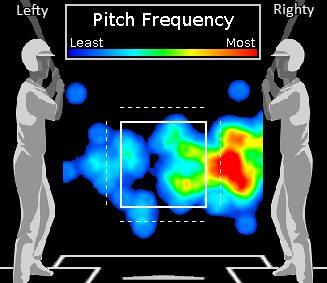
Location of Fister's fastball vs. Texas, 10/11/2011

Seventy percent of Fister's fastballs were thrown inside, 21 percent were tossed outside and just nine percent caught the middle part of the plate. Rangers batters got very few cookies, and they couldn't really back off the plate to better handle those inside pitches with Fister also working the outside corner at times.

You'll note that most of those fastballs were thrown out of the zone. In fact, just one-third of Fister's fastballs were over the plate. But Texas hitters couldn't lay off, chasing 32 of 51 out-of-zone heaters (63 percent). That's nothing new for Fister, though: he leads all MLB starters in fastball chase percentage this season.

While he's not a power pitcher, the former non-prospect has improved his fastball velocity considerably -- he sat at 91 mph Tuesday and hit 93 -- while still featuring lots of movement. On average, Fister's fastball tailed in on righties by about 10 inches compared to a pitch thrown without spin. The average for righty fastballs is slightly more than half of that.

Combining average velocity with that much movement makes Fister's fastball a plus offering. Opponents have slugged just .319 against the pitch this season, the lowest clip among qualified MLB starters.

With each passing start, the six-player swap that brought Fister (under team control through 2015) to Detroit in July looks like even more of a masterstroke. Armed with a darting fastball that has climbed from the high-80s, Fister is no novelty act. He's just one of the best starters in the DH league.